Key Takeaways
- Most U.S. door locks are pin tumbler cylinders: spring-loaded pin stacks block a rotating plug until the right key lines every gap up on the shear line.
- ANSI/BHMA Grades 1, 2 and 3 rate durability and strength. Grade 1 is commercial-duty; Grade 3 is light residential.
- UL 437 is a separate listing for key locks that resist picking, drilling, and other attacks for set test periods — it's how "high-security" is usually proven.
- Key control (restricted or patented keyways) decides who can copy your keys — often more important than pick resistance.
- The lock is one part of a system: the bolt, strike plate, screws, door and frame all matter.
The Pin Tumbler, Piece by Piece
Pick up almost any house key in America and you are holding the other half of a pin tumbler lock. The design is old — its modern form was patented in the 1860s — and it remains the default for front doors, padlocks, and commercial cylinders because it is cheap to make, easy to rekey, and reasonably hard to defeat when built well.
Inside the cylinder there are two main parts. The housing (sometimes called the shell or hull) is fixed to the door. Inside it sits the plug, a smaller cylinder that holds the keyway and can rotate. When the plug turns, a cam or tailpiece at its back moves the latch or bolt. The boundary between plug and housing is the shear line.
Drilled across that boundary is a row of chambers, usually five or six on a residential lock. Each chamber holds a stack: a spring on top, a driver pin beneath it, and a key pin at the bottom that touches the key. With no key in the lock, the springs push every stack down so that the driver pins straddle the shear line, physically pinning plug to housing.
The key pins are cut to different lengths. The correct key has a cut — a valley of a specific depth — under each chamber. When it is fully inserted, each cut lifts its key pin just far enough that the top of the key pin, and the bottom of the driver pin, meet exactly at the shear line. With every gap aligned, nothing crosses the boundary and the plug turns. A wrong key leaves at least one stack too high or too low, and the plug stays locked.
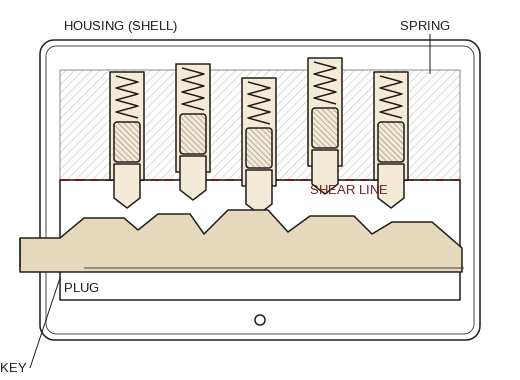
Use the slider or the buttons to insert a key.
- Spring
- Sits on top of each stack and pushes the pins down into the plug.
- Driver pin
- The upper, flat-ended pin. With no key, it straddles the shear line and blocks rotation.
- Key pin
- The lower pin, cut to different lengths. It rides on the key and is what a rekey changes.
- Plug
- The inner cylinder that turns. It holds the keyway and drives the cam or tailpiece.
- Shear line
- The gap between plug and housing. When every pin gap aligns here, the plug can rotate.
- Housing
- The fixed outer shell (also called the hull or bible) that holds the upper chambers.
Two details explain most of what locksmiths do with these locks. First, rekeying means replacing the key pins (and sometimes drivers) so a different key aligns them; the lock body stays on the door. Second, master keying adds thin extra pins, called master wafers, so two different keys can each create an aligned gap. That convenience creates extra gaps, which is why master-keyed cylinders are generally easier to manipulate than single-keyed ones.
Better pin tumbler cylinders add security pins such as spools and serrated drivers that catch during picking, hardened steel inserts that resist drilling, tighter machining tolerances, and sidebars or secondary locking elements that a second feature on the key must also satisfy.
Wafer, Disc Detainer, Lever and Electronic Locks
Wafer locks
A wafer lock replaces pin stacks with flat, spring-loaded plates (wafers), each with a rectangular window the key passes through. The key's cuts position each wafer so it sits fully inside the plug. They are compact and inexpensive, so you find them in desk drawers, mailboxes, filing cabinets, vending machines, and many vehicle doors and ignitions. Most simple wafer locks offer modest security; automotive versions are often double-sided and more precise.
Disc detainer locks
A disc detainer stacks rotating discs, each with a notch (gate). The key doesn't lift anything — it rotates each disc by a set angle until all the gates line up and a sidebar can drop in, freeing the core. There are no springs to bounce, so bump keys don't work on them, and quality versions are hard to pick. They are common on high-end padlocks, some bike locks, and in Europe on door cylinders.
Lever locks
Lever locks use a set of flat, pivoting levers. The key's steps lift each lever to the exact height where a slot (the gate) aligns with a post on the bolt, letting the bolt slide. They appear on safe-deposit boxes, some safes, and older mortise locks. A well-made lever lock with many levers can be very secure, though the long keys are bulky.
Electronic and smart locks
An electronic lock replaces or supplements the key with a keypad, card, fob, or phone. Inside, a motor or solenoid moves the bolt or frees the handle. Three questions matter more than the app: Is the bolt and housing built to a recognized BHMA grade? What mechanical override exists — and is that cylinder any good? And how are codes, users and audit logs managed? A keypad deadbolt with a cheap backup cylinder is only as strong as that cylinder.
| Mechanism | Where you'll see it | Can it be rekeyed? | Typical weakness |
|---|---|---|---|
| Pin tumbler | Front doors, padlocks, commercial cylinders | Yes, usually on site | Picking and bumping on low-end models |
| Wafer | Cabinets, mailboxes, many vehicles | Sometimes; often replaced | Low tolerances, simple bypasses |
| Disc detainer | High-end padlocks, some cylinders | Depends on brand | Cheap copies; poor shackle or body |
| Lever | Safe-deposit boxes, older mortise locks | Some models | Few levers on cheap versions |
| Electronic / smart | Keypad deadbolts, offices | Codes change in seconds; backup cylinder rekeys | Weak override cylinder, poor code habits |
ANSI/BHMA Grades 1, 2 and 3
The Builders Hardware Manufacturers Association (BHMA) writes a family of American National Standards — the A156 series — for door hardware. Separate standards cover bored locks and latches, deadbolts, mortise locks, and cylinders. Under them, products are tested for operational cycles (how many times they can be locked and unlocked), strength (how much force, torque and impact they withstand), and finish durability, then assigned a grade.
- Grade 1 — the most demanding. Built for commercial and heavy-use doors. The cycle and strength tests are the toughest.
- Grade 2 — heavier residential and light commercial. A solid choice for most exterior home doors.
- Grade 3 — light residential. Acceptable for interior doors; marginal for the door that faces the street.
Some residential products also show BHMA's letter ratings (A, AA, AAA) for security, durability, and finish on the box. Those are a different, consumer-oriented label; treat them as an additional data point, not a substitute for the grade.
What a grade does not tell you: how well the cylinder resists picking or bumping, whether the keys can be copied at any hardware store, or how the lock performs in a soft wood frame held by short screws. A Grade 1 deadbolt fastened into a split jamb with 3/4-inch screws is still a weak door. That is why the Home Security chapter spends as much time on strike plates as on locks.
What UL 437 Means on a High-Security Lock
UL 437, the Standard for Key Locks, is published by UL Standards & Engagement and is the benchmark most U.S. manufacturers use to substantiate a "high-security" claim. A lock or cylinder listed to UL 437 has been tested against defined attacks — including picking, impressioning, drilling, pulling, prying and torque — for specified time periods, and checked for features that resist unauthorized key duplication. Products are evaluated by category (for example, door locks and cylinders, safe locks, and others), so the listing applies to a particular product type.
BHMA also publishes a separate standard for high-security cylinders (ANSI/BHMA A156.30). Seeing either reference is a good sign; seeing the words "high-security" with no standard named is marketing.
Ask for the model number and look for it in the certifier's own directory. A brand may sell both listed and non-listed lines that look alike. "UL-tested" on a box is not the same as a current UL listing for that exact model.
A UL 437 cylinder costs more to buy, rekey, and duplicate. For many homes, money is better spent first on a Grade 1 or 2 deadbolt and a reinforced strike; high-security cylinders earn their price where key control matters — rentals with frequent turnover, shared buildings, small businesses, or homes where too many copies of a key have circulated.
Key Control: Restricted and Patented Keys
The most common way a lock is defeated is not picking. It's a working key in the wrong hands: a former tenant, a contractor who made a copy, a key left under the mat. Key control is the set of measures that limit who can make a copy.
- Standard keyways. Blanks are sold everywhere. Anyone holding your key can copy it at a kiosk. "Do Not Duplicate" stamped on the bow is a request, not a barrier.
- Restricted keyways. The manufacturer sells blanks only to authorized dealers in a defined territory. The dealer keeps records and typically requires a signature or ID card from an authorized person.
- Patented keyways. A utility patent on the key profile legally prevents other companies from producing the blank while the patent is in force. Once it expires, the protection falls back to distribution control, so ask how long the patent has left.
- Registered systems. Some manufacturers register a key system to the owner and record every authorized signer, so even the dealer can't cut a key for someone off the list.
Scenario: you own a small rental with six units and change tenants twice a year. Rekeying standard cylinders each time is affordable, but you can't control copies between turnovers. Moving to a restricted keyway with a signed authorization list means tenants can't duplicate keys at all, and you rekey only when one is actually lost.
Reading the Package Before You Buy
- Find the grade. Look for "ANSI/BHMA Grade 1" or "Grade 2" and the standard number. No grade listed usually means Grade 3 or untested.
- Measure your door. Check the backset (2-3/8" or 2-3/4"), door thickness, and bore size so you don't buy the wrong hardware.
- Check the bolt and strike. A full 1-inch bolt throw and a reinforced strike with long screws are worth more than a fancy finish.
- Ask about the keyway. Do you need several locks keyed alike? Buy the same brand and keyway, or ask for them keyed alike at purchase.
- For high-security claims, ask which standard (UL 437, ANSI/BHMA A156.30) and look up the exact model.
- For smart locks, confirm the BHMA grade, the mechanical override, battery warnings, and how you remove a user's access.
Questions Readers Ask
Is a Grade 1 deadbolt always the best choice for a house?
Grade 1 is the most demanding ANSI/BHMA performance grade and is a sound choice for an exterior door, but the door frame, strike plate and screws decide how well it resists a kick. A Grade 2 deadbolt in a reinforced frame can outperform a Grade 1 bolt in a weak one.
What does UL 437 mean on a lock?
It means the cylinder or lock model was tested and listed by UL to its Standard for Key Locks, which evaluates resistance to attacks such as picking, impressioning, drilling, and forcing for set time periods. Check that the specific model, not just the brand, is listed.
Can any locksmith copy a restricted key?
No. Restricted and patented keyways use blanks that are distributed only to authorized dealers, who typically require an authorization card or signature from the registered owner before cutting a copy.
Are smart locks less secure than mechanical locks?
Not inherently. A smart lock still has a mechanical bolt, and many include a key cylinder. Judge it by its BHMA grade, the quality of its key override, how it handles codes and app access, and what happens when the battery dies.
Sources
- Builders Hardware Manufacturers Association (BHMA) — ANSI/BHMA A156 standards and grading: buildershardware.com
- UL Standards & Engagement — UL 437, Standard for Key Locks: shopulstandards.com
- UL Product iQ certification directory (look up listed models): productiq.ulprospector.com
- ALOA Security Professionals Association — certification exam categories (cylinder servicing, master keying): aloa.org/certifications
- Federal Trade Commission — "FTC Urges Consumers to Use Caution When Seeking a Locksmith": ftc.gov